


India’s growing economy and increasing prominence as a global business destination make it an attractive market for foreign acquisitions. With an expected GDP growth of 6.6% by FY 2026, fueled by robust government reforms, India presents vast opportunities across diverse sectors. Yet, navigating India’s regulatory landscape requires strategic planning, a comprehensive understanding of its legal frameworks, and attention to regional variations. This article explores the essential regulatory and strategic considerations foreign buyers should understand to enter India successfully, covering market potential, sector-specific opportunities, regulatory frameworks, acquisition models, and post-acquisition strategies.
India’s Market Potential for Foreign Buyers
India’s position as a rapidly developing economy, combined with a demographic dividend (median age of 28.4 years) and robust consumer demand, strengthens its appeal for foreign acquisitions. In FY 2023-24, India attracted $71 billion in Foreign Direct Investment (FDI), with a 26.4% increase in Q1 of FY 2024-25. This growth reflects India’s economic resilience, particularly in sectors like technology, healthcare, and renewable energy.
Key drivers of India’s growth include economic stability, proactive fiscal policies, and initiatives like the “Digital India” campaign, which fuels expansion in sectors like e-commerce, fintech, and software-as-a-service (SaaS). India’s digital economy is anticipated to contribute over 20% to GDP by 2026, reinforcing the potential for foreign entities to establish a robust presence.
Key Sectors of Growth

1. Technology
India’s tech ecosystem is one of the world’s fastest-growing, propelled by a skilled workforce, government initiatives, and strong demand for digital solutions. With the “Digital India” program, the digital economy is expected to drive 20% of GDP by 2026, presenting opportunities in SaaS, e-commerce, and fintech.
2. Renewable Energy
India has set ambitious goals to reach a renewable energy capacity of 450 GW by 2030. This includes solar, wind, and green technology initiatives. With strong government support, foreign investors can tap into sustainable energy projects, aligning with global trends toward environmentally responsible investments.
3. Healthcare
Post-pandemic, India’s healthcare and pharmaceutical sectors are seeing substantial foreign interest, particularly in biotechnology and pharmaceutical manufacturing. With a robust manufacturing base and focus on R&D, India is becoming a key player in the global healthcare industry.
4. Infrastructure
Infrastructure development is a priority for India, with large-scale government projects aimed at improving logistics and supply chains. This sector presents opportunities in logistics, construction, and supply chain management for foreign investors looking to leverage India’s expanding infrastructure.
Government Reforms and Investment Incentives
1. “Make in India” and Production Linked Incentive (PLI) Schemes
These initiatives focus on expanding local manufacturing and fostering innovation. By offering financial incentives to companies meeting specific production goals, the schemes encourage foreign companies to establish operations in India in sectors such as electronics, automotive, and renewable energy.
2. State-Level Incentives
Indian states, such as Maharashtra, Karnataka, and Tamil Nadu, offer industry-specific incentives to attract foreign investors. These include tax breaks, lower stamp duties, and subsidies, particularly in priority sectors like manufacturing. Uttar Pradesh, for instance, recently simplified its FDI entry processes, making it an attractive destination for new investments.
Regulatory Framework for Foreign Acquisitions
1. The Foreign Exchange Management Act (FEMA)
FEMA is the cornerstone of India’s foreign investment regulations, guiding FDI, Foreign Portfolio Investment (FPI), and Foreign Venture Capital Investment (FVCI). FEMA outlines two main routes for FDI:
- Automatic Route: Sectors like manufacturing and agriculture allow automatic FDI entry without prior approval.
- Government Route: Sensitive sectors, including telecommunications and defense, require government approval to ensure alignment with national interests.
2. FDI and FPI Considerations
SEBI governs the FPI model for foreign investment in India’s equity markets, maintaining ownership limits for market stability. The Foreign Venture Capital Investment (FVCI) route provides access to India’s innovation-driven economy, especially beneficial for investments in tech and healthcare.
3. State and Sector-Specific Compliance
Compliance requirements vary across states. Manufacturing-intensive regions like Tamil Nadu offer tax breaks and streamlined processes for manufacturing firms. Adherence to both central and regional regulations is critical for sustainable operations and effective market entry.
Acquisition Strategies: Models for Entering the Indian Market
Different acquisition models allow foreign buyers to enter the Indian market based on their strategic goals and risk tolerance:
1. Joint Ventures (27%)
Joint ventures allow foreign firms to partner with local companies, sharing risks and benefiting from local expertise. This model is particularly popular among investors cautious of navigating complex regulatory environments.
2. Full Acquisitions (25%)
In this model, foreign entities acquire full control over a company, gaining seamless operational integration. However, this model carries higher risk due to inherited liabilities and regulatory complexities.
3. Strategic Partnerships
These partnerships combine global expertise with local insights, facilitating market entry with shared responsibilities. This model is especially advantageous in sectors like technology, where local knowledge is crucial for competitive success.
Types of Acquisition Models
1. Asset Acquisition
This involves purchasing specific assets (e.g., manufacturing facilities or technology) without acquiring full company liabilities, making it suitable for investors interested in targeted investments.
2. Share Acquisition
By acquiring shares, foreign investors gain control over the acquired company, including its customer base and workforce. However, they also inherit all legal and financial obligations.
3. Vertical Acquisition
This model involves acquiring businesses within the supply chain (either upstream suppliers or downstream distributors), enhancing operational efficiency and reducing dependency on external suppliers.
Due Diligence Essentials
Thorough due diligence is critical in acquisitions to evaluate financial, legal, and cultural factors:
1. Financial Review
Assessing profitability, liabilities, and tax compliance is essential. India’s tax structure, governed by the Income Tax Act, 1961, and GST regulations, requires careful review to identify risks.
2. Legal and Regulatory Compliance
Due diligence must assess adherence to FEMA and the Companies Act, 2013. Regulatory approvals from authorities like SEBI and the Competition Commission of India (CCI) are often necessary for M&A activities.
3. Cultural and HR Due Diligence
Evaluating HR policies, turnover rates, and employee relations is vital for post-acquisition integration. Cultural compatibility is key to aligning corporate cultures and minimizing friction.
Post-Acquisition Integration Strategies
1. Cultural Integration
Aligning the cultural values of both companies is essential for post-acquisition success. Transparent communication and employee engagement foster a cohesive environment and smooth transitions.
2. Operational Integration
Clearly defined timelines and cross-functional teams are crucial for successful integration. Leveraging digital tools and focusing on operational efficiency enhances synergy and reduces disruptions.
3. Talent Retention
Retaining key talent post-acquisition is essential. Retention packages and development opportunities help maintain a competitive team while addressing employee concerns about job security.
Case Studies: Key Acquisitions in India
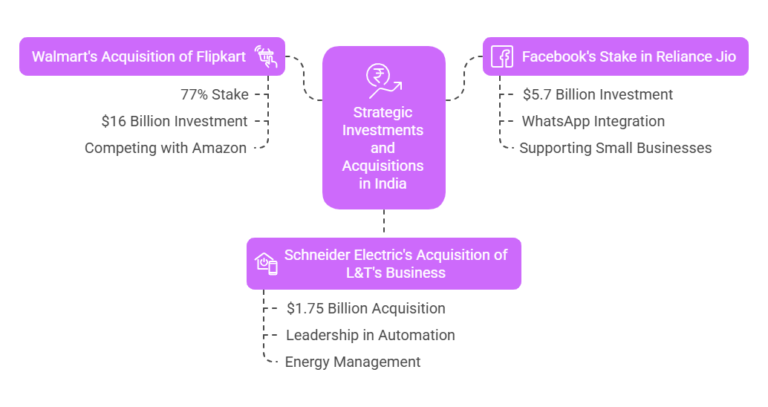
1. Walmart’s Acquisition of Flipkart
In 2018, Walmart acquired a 77% stake in Flipkart for $16 billion, giving it a foothold in India’s e-commerce market. Walmart leveraged Flipkart’s market insights and reach to compete effectively with Amazon in India.
2. Facebook’s Stake in Reliance Jio
Facebook’s $5.7 billion investment in Reliance Jio facilitated the integration of WhatsApp with Jio’s ecosystem, empowering small businesses and local merchants in India’s informal retail sector.
3. Schneider Electric’s Acquisition of L&T’s Electrical and Automation Business
Schneider Electric’s $1.75 billion acquisition of L&T’s Electrical and Automation business in 2020 positioned Schneider as a leader in India’s automation and energy management sectors.
Future Trends and Emerging Sectors
India’s high-growth sectors—healthcare, renewable energy, and infrastructure—present strong acquisition opportunities. Government-led infrastructure initiatives drive interest in logistics and construction. Additionally, Environmental, Social, and Governance (ESG) standards are increasingly important, with one-third of investors prioritizing firms with robust ESG frameworks. Investors can expect steady growth rates, with India’s average annual growth rate projected at 5.4% through 2050.
Conclusion
Navigating India’s regulatory landscape is complex but rewarding for foreign investors prepared to engage in long-term strategic planning. By selecting the right acquisition model, conducting thorough due diligence, and focusing on cultural integration, foreign buyers can capitalize on India’s economic potential. India’s supportive regulatory environment, combined with high-growth sectors, offers significant opportunities for foreign companies willing to commit to India’s dynamic and diverse market.